Monday, February 20, 2006

Jiminy Cricket wears a curly wig

In Austria, David Irving is sentenced to 3 years for denying the Holocaust in an interview 17 years ago. Since then, he's changed his mind:
"I said that then based on my knowledge at the time, but by 1991 when I came across the Eichmann papers, I wasn't saying that anymore and I wouldn't say that now," Irving told the court.

Even Deborah Lipstadt, who Irving tried to sue for libel in the UK in 2000, recognises the ridiculous of the situation:
"I am not happy when censorship wins, and I don't believe in winning battles via censorship... The way of fighting Holocaust deniers is with history and with truth"

Personally, as a commentator, I don't profess to have any historical knowledge on the matter. On this point, I freely admit to believing in something merely because others have told me about it. While I like to question assumptions, it would become rather silly to disbelieve everything and anything until I had verified it with my own eyes.

But I do indeed digress. Or do I? The question, then, is whether history is a science, or an art. The science of determining what has happened, or the art of maintaining an archive, and drawing links and lines of cause and effect through time. In the end, of course, it will be a bit of both - we need to establish truth, but we also need to understand where we have come from. The important point is to learn from our past.

But the concern here, legally speaking, is this split between the two - how much one can risk affronting emotion in the search for knowledge. Nobody argues with the idea that much of history is written by the winners, which is effectively another way of saying that history becomes what people want it to become. Memories are filled with soul, and our souls are generated from our memories.

I haven't time to delve to deeply into Irving's past, and his legal clashes with Lipstadt. If, as he says, he has changed his tune following his own, personal discovery of further "evidence", then he is acting as a scientist. Lipstadt is right to point out that this is a much preferred method of resolution than "simple" censorship.

Yet with the gradual onslaught of the psychological and juridical science domains, we are left increasingly with a view of the individual as an automata. We are painted as being rational and "free" so long as we remain on societal track. Our decisions are our own. But once we enter the justice system, quite often we lose this shield of perceived "freedom". Our actions are unhelpable, our motivations are driven by forces we cannot control, forces that exist naturally but that somehow occur outside of sense of "choice".

Increasingly, then, a single action is extrapolated into our mindset in totality. Pop Media amplifies this "dehumanisation", turning the middle aged man who accidentally catches sight of a 14-year-old girl in a short skirt into a raging paedophile. We have mastered the links between "effect" and "cause" and, because we have statistics to prove it, we believe the link and nothing more. Or less.

What are the implications for the idea of human fallibility, for occasional frailty? When we end up with a judicial system that becomes so keen to extract (penal) guilt from intention, and that loses the power to believe in the reversibility of the human "conscience"? If Irving is basing his opinion on what he knows, and changes his opinion accordingly, but still gets 3 years for what he now knows is wrong, where does that leave the rest of us? How can we even trust history so long as it has some emotional content to it?

Clay Shirky brought this up as the most dangerous idea for coming decades. Richard Veryard notices move from questioning to employability in education. Just how easy is it to forget that we may actually have some control over ourselves, and some say in the world we live in?

Monday, February 13, 2006

Some new ground, but same old arguments

Hurrah, some movement. New legislation will be required to make ID cards compulsory. Meanwhile, Blair trots out the usual rubbish:

"People have this idea that there's a problem in civil liberties with people having an identity card and an identity registered today when across all walks of our life this is happening."

Politicians just don't get this idea that it's not how necessarily much information is out there about you - it's about who has access to how much in one go. Yes, there are serious concerns abut publically-available information (via Google, for example), which need to be addressed. Gathering all the information together under the eyes of a pompous government isn't an "inevitable" step in the slightest.

Sainsbury's do not need to know how often I visit the Doctor's, just as insurance companies are not allowed to know the results of genetic tests for diseases. This is a much, much bigger issue than people realise, or that I have time for today. Maybe soon.

Wake up to Brown's terror threat

Gordon Brown plays the "fear for your lives" card this weekend, a day before votes are due to be cast on the latest round of the ID card push. How odd. Time and time again, the Home Office have told us that ID cards were never intended to be a panacea or a sole solution for terrorism, witness:

"I must emphasise that we have never said that the identity cards scheme is intended to be the sole solution to ... terrorism. The scheme is therefore not being designed to be the primary method of combating these problems." - letter from Des Browne, 13 Jan 2005. Emphasis mine.

Yet on Radio 4's Today, Brown's cited as saying:

"If you take the Ricin plot ... there were 12 main suspects, they had 120 separate identities ... If you take one of the 11 September terrorists in America, he was operating with 20 false identities so he could not be spotted.

"It is absolutely crucial to the disruption of terrorism that you can spot quickly where multiple identities are being used.
"


Well, make up your minds. Do you want us to be scared or at ease?

The above Today quote is from an article concerning Blair missing the vote due to technical difficulties - his plane's engine has a problem. That's the problem with technlogy, isn't it? It always fails just at the most inopportune moments. Maybe it's a hint.

Wednesday, February 01, 2006

Meanwhile, back in UKPS...

Blogging must go in waves... nothing for ages, then about 3 in a day.

I've finally gotten around to reading - and recommending - an article from the Register last week about the introduction of passport biometrics and its link with ID Cards.

Having just watched an episode of "Yes, Minister", my policynical-radar is twitching, and now I realise it would be wrong to think that Whitehall doesn't have some arguments-in-preparation going on. The article is pretty lengthy, but the gist of it is that much of what the ID card promises (biometrics, databases, etc) is already underway for passports anyway. Once it's in place, saying "oh, but we already have 75% of the infrastructure in place" will probably become a very convincing argument. Who wants to scrap a plan once the money's been spent on it? And who gives a fiddling monkey about what effects it'll have aside from the financials?

Not us, hum.

Reading for Today

If you read one thing today (apart from this post), make it Chick Yog's post on ideas, supermarkets, political debate and jet-propelled nurses:

Chicken Yoghurt: Battlefield Medicine

Tuesday, January 31, 2006

An ID card for each identity

A "curious" BBC news story from yesterday: Transsexuals 'to get 2 ID cards':

Transsexuals who have yet to have a sex-change operation will be entitled to two ID cards, Home Office Minister Lady Scotland of Asthal has said.

One would be in their gender at birth and the other in their legally-acquired "gender of designation".

It doesn't make clear whether this is as a "side-effect" of the proposed legislation, or a "feature" that the Lords have introduced. Alas, I haven't the time to check Hansard on it ("peer review", a-harr), so consider this a "bookmark for later" post.

The idea of what constitutes a unique "identity" is certainly a fascinating one...

Monday, January 30, 2006

Why Britain Sucks: The "Education" Rant

A productive, informed, happy nation (IMHO) is built upon a foundation of education - education that informs, but also education that encourages both participation and self-reliance. Unfortunately, there's a rather large study that says we're getting less intelligent.

Anyone that's actually been in the education system (rather than merely deciding what the fad subject is this year and trying to get more girls to do it) will be aware of the effect that testing has - and I highlight "effect" because this is why we're "deliberately" dumbed down. The more tests we're given, and the more league tables that depend on the tests there are, the more people are "configured" to optimise test performance by whatever means necessary. The very act of measurement has a very real effect on that being measured.

It's the same with University "Research Assessment Exercises" (RAEs), with driving tests, and possibly even with dental check-ups. You do what you can to pass, then go your own way afterwards. The amount to which education affects your progress after that could be said to be inversely proportional to the effort it's putting in to getting you through those tests. The more tests you have, the less you actually think.

But here's the scary thing. We live in a world where numbers, comparisons and measurements are the driving force of the future. When we talk about knowledge-based societies, we're talking about "tangible", codified knowledge that other people can pick up on, that can be used to make judgements, that can be fed into a computer and used to create charts or diagrams or what-have-you. So long as databases are the premium way of assessing the "health" of a nation, we will be subjected to quantitative tests which will have to be logically-tied to performance.

This means that there must be a simple mapping, from knowledge, to judgement. Things are either right or wrong. There is no longer an art or a craft to working out how well an individual is doing for themselves, nor where their future potential lies, there is only how they react under the test conditions, and how well they "rate" against others of the same classification scheme (gender, age, race, height, social background, medical discrepancies).

This is a system which categorises, sorts, and filters - a "classification" system, not an educational one. The lucky go on to become millionaires. The unlucky are squabbled over by a few persistents who have a million to share out amongst them. But the terms of existence are decided in advance, by the people who just have to have a way of working out who's better than who.

The problem is, selection criteria are subjective. Who defines success? Why, the already-successful, of course.

Sunday, January 15, 2006

Chickens coming home to roost

According to today's Independent, MPs are getting a little upset about losing their right (or "privelige" today) to not be wiretapped.
MPs should be treated in the same way as other citizens and will be given the same safeguards against wrongful tapping, the Prime Minister will say.

While he's got the right stick - MPs are just people, after all, and shouldn't necessarily be afforded all kinds of fancies - he gets completely the wrong end of the stick.

It's funny, isn't it? You spend all this time complaining to MPs about privacy of the individual and such, and they bat you away citing terror concerns. Bollocks to 'em, I say. If the only time they make a stand for "principles" is when it's their skin at stake, then they're getting as much as they deserve. Perhaps there is some kind of justice in the world after all...

Wednesday, January 11, 2006

Blair Blathers Blindly

What the frigging ferrets..? I go off, read some books, and when I come back all the party leaders are "podcasting" like mad! Ah, they're all so trendy and hip. I wish I was like them. Next thing you know, they'll have webpages.

But, digression in progress. I haven't bothered to listen to the Telegraph's Cameron podcast yet. Plenty time. I have grabbed the Prime Minister from the clutching grasp of the Sun though, and proceeded to vomit casually all over my keyboard. Of cours,e the problem with Podcasts is there's generally very little you can copy and paste from them. So I'm going to have to do some of my own transcripting to induce you into a similar vomit-involved situation. Fortunately, it's not very long. Probably something to do with attention spans of the target audience. I'll leave in some choice umms, but otherwise be a little more sporting than the "Just a Minute" style. I'll also leave it uninterrupted, and add my comments at the end. Here goes. Oh, and it's Pascoe-Watson, not Basket-Watson as I heard first time.


George Pascoe-Watson: This is George-Pascoe Watson, the Sun's political editor, with the Prime Minister Tony Blair in the heart of Downing Street, with the Sun's first ever podcast. Mr Blair, how would you encourage Sun readers to get involved in identifying the problem yobs in society?

Prime Minister: We're only going to be able to beat this problem if we all work together, and the vast majority of families and people in this country play by the rules. But there are a small minority who make life misery for their neighbours, and communities. And for a long time they believed they could get away with this bad behaviour. Either because they think the victims are too frightened to report them, or they feel nothing will be done even if they did report them. Slowly, in commmunities up and down the land, these thugs are learning that the rules are changing. Police, councils and local people are using the new powers we've given them to put the decent majority back in charge of their neighbourhoods. And where these powers are being used, they're having a dramatic impact. And I want to see them used right across the country. But I recognise there's still a great deal to do, so yesterday I announced a raft of new measures to step up the drive against anti-social behaviour, and that's also why I welcome the Sun campaign to help its readers identify those people who are causing real trouble in their communities. We'll make sure these names are passed on in complete confidence to the authorities, who will take action if it's needed. None of us alone, not even government can put respect back at the heart of our communities. but acting together, we can and we will.

GPW: So you actually want Sun readers whose lives are often blighted by these, uh, thugs to actually take responsibility for their communities?

PM: Yes, and realise that we're there and will back them up. Because often people are very frightened to shop people when they've got a situation where someone is perhaps causing a persistent nuisance to them, making their life difficult or hell, or they're maybe using a house in the street for drug dealing, or various kinds of anti-social behaviour, and this is a way that people can pass on this information, and then it can be checked out by the authorities. And, you know I think it's important to realise that we're giving summary powers to the police and local authorities to act, and these are tough powers. Now in the end, though, it only works if everyone's working together. Not just government giving the resources and the powers, but police and the local authorities and local people backing it up.

GPW: So it's very important that people realise you're giving them a sense of, uh, responsibility for the societies in which they live?

PM: Yes, because in the end, I can't do it sitting in Downing Street...

GPW: You can't, you can't go down their street and ...

PM: No, no, you know, sometimes you wish you could, but you can't. But it's up to people to work with the authorities and we're trying therefore to give them this opportunity to contact the authorities in confidence, and to realise that we are actually there, on their side, giving these new powers, and we can use them.

GPW: I think it's an important point you make - that people, for a long time, have felt that they are powerless to act. And you're saying to them, "you're not powerless to act, you know, here's an opportunity"

PM: Yes, I mean, some of the new powers - for example a pub or a club that's continually the scene of rowdy scenes outside with fighting and drunken behaviour, the police will have the power to shut the club - or pub - and trigger a review of their entire licence. Umm, people who use their home for persistent anti-social behaviour will be evicted - and this can happen even for a private property - if they carry on causing absolute mayhem in their local community - it can be done. Umm, where you've got gangs of youths hanging around and they're refusing to disperse, you can put fixed penalty notices on them, which will be up to 100 pounds now. Where drug dealers are, um, you know, driving down the street in a fancy car with a lot of cash on them, the police will be able to take the cash, uh, and the drug dealer will have to - or the suspected drug dealer - will have to come and prove that they got it lawfully, to get it back. You know, these powers are *tough*. Umm, where there are parents out with their kids in the middle of the day when their kids should be at school, you know, they can be subject to penalties...

GPW: Truancy is something else you're tackling today...

PM: Yeah, because it's important - I mean, this is a responsibility, of course, of police and local authorities, but primarily it's a responsibility of parents to make sure they get their kids to school...

GPW: And you basically want to tell Sun readers that you are on their side today?

PM: It's essential for people to realise thet we are there, on their side, to help get this done. We can't do it all ourselves, but we can enable people to do it for themselves.

GPW: Prime Minister, thank you very much.

PM: Thank you.


Phew. OK, well I should come clean first off, and admit that I haven't been keeping up with this respect malarkey the last couple of days. Background reading will be here and here, to start with.

But in between the fawning over the PM that Pascoe-Watson does (they interrupt each other, so there's less chance that they're the same person, but then Beavis and Butthead were the same guy...), Blair reveals his own desperation to look like he's doing something, yet again. I'm tough, I'm harsh, but I reward the good and love me oh Sun readers love me etc etc.

Unfortunately, he also shows just how muddled up he is, and just how misguided New Labour's crappy Old Thinking is.

Respect and Power are the two words you want to pay attention to here, for they're both interlinked more than anyone makes out. For instance, if I have power over you, then I have no need to respect you. Blair has a lot of power over the people of Britain, but I don't see him paying them/us much respect either. Otherwise we might have a decent voting system and a criminal justice system (rather than simply a criminal system). If he wants us to respect him for the "good work" he's putting in to make our lives nicer, then he's going to have to do a lot better than the simpering, crawling "oh look, if we work together we can sort this mess out" shite:

"We're only going to be able to beat this problem if we all work together..."

"...in the end, though, it only works if everyone's working together..."

"...it's up to people to work with the authorities..."

Oh hurrah, some responsibility? In this day and age? Heavens, responsibility's about the one thing that can save us now - responsibility to have some say over how things are run, over what happens in our neighbourhoods, responsibility for each other. So Tony's going to hand it to us is he? Bollocks he is. This sums it all up in a nutshell:

"I welcome the Sun campaign to help its readers identify those people who are causing real trouble in their communities. We'll make sure these names are passed on in complete confidence to the authorities, who will take action if it's needed."

That's right. You do the "shopping", and we'll actually handle things. You tell us what's wrong in your community, and we'll take it from there, send the boys in black in and move the troublemakers on (to do it somewhere else). Sorted. That's the responsibility you have. Telltale. Want to actually take measures to improve your neighbourhood, get people involved locally rather than excluding them, kicking them on to a soon-to-be-turned-into-a-prison community? Forget that, just let us know, and we'll arrest the bleeders.

Some people will naturally claim that tough justice, zero-tolerance, etc is a fair way forward. Here's one that argues it on the grounds of efficiency. This might be valid in some situations, but to argue for it in all cases of "anti-social" behaviour is missing the Big Picture That Sits On Your Face And Laughs.

The Telegraph's leader comment is on the right track:

"respect" has a different meaning among Britain's urban youth to that intended by Tony Blair. The word refers to the hierarchy of riches and violence that raises such terrible role models for the young; it is the code by which the weak must make way for the strong and ill-gotten wealth is preferred to honest graft.

It's no coincidence that while we are growing slack on the civility side of things (which is what Blair probably means instead), we are increasingly immersing ourselves in a culture where power, fame and money have become the benchmarks for success.

This is not a Hollywood image. This is a very real, fundamental set of values that we are plunged into the moment we're born. It's not just rap stars and DJs that give us these values. We see business-people, flanked by glass-fronted London tower-blocks, jumping in their chauffeur-driven limos, driving to their 3-kitchen country home at the weekends. We have TV programmes about buying and selling houses for profit, magazines on how to be the sexiest person ever, and adverts at every corner that are just crying out for shiny printing to be invented.

The problem is that these are all the things that Blair wants. An ever-growing economy relies on people making more and more money, which requires people to buy more and more stuff, which means that riches become increasingly a sign of status. Flash buildings are symbols of fiscal performance, international emblems that are designed to reflect something that we have and others don't.

Is it any surprise, then, that the people who most often end up embroiled in drunken, rowdy (if not maliciously-intended - I've been there...), "yobbish" antics are the very same people who hire out SUV limos for birthdays, who lust after the latest bling technology, and who will quite happily sell out their "acquaintances" for a shot at the "good life"? I don't care if I'm over-generalising. I'm saying that this happens, and on a large scale because it's what's expected.

This is the generation growing up surrounded by a competitive world, and in harsh (global, even) competition, if you respect people you don't need to, you're going to lose. That's why this backwards-arsed country is going to get far worse before any "tough measures" clear it up. The problem is Blair's too blind to tie the two together.

Wednesday, January 04, 2006

Eyeballing the Eyeballers

Thanks must go to Richard Veryard for bringing this Wired article on playing with CCTV to my attention. Unfortunately the website set up by Quintessenz, www.vam.com, doesn't seem to be responding at the moment. But nevertheless, now you too can watch the watchers via a simple Google search.

Stuttgart airport, for instance, might interest the plane-spotters amongst you.

Tuesday, January 03, 2006

"Tagging": Buzzword of the 21st Century

Hello, and a happy new year to all. Things have been a but quiet here recently as festivities have taken their well-earned toll. Part 2 still to come, but catching up with some news snippets in the meantime...

Nanny state, nanny state, gotta have a nanny state... Hutton wants to tag absentee dads now if they're not paying their fair share of child support. Uh.. why? I can be in the same road as someone and never see them. Or is the default response to any irritating behaviour now to restrict people's movement?

Meanwhile, the Home Office reminds us that there are always, annoyingly, people involved in any kind of system, despite however much the government tell us computers will take care of all the work. Gah. Inquiry into 'sex for visa' claim.

Wednesday, December 21, 2005

Boom Bang a Bang

BBC are reporting that a teenager has been held over 'bomb making', and that "four controlled explosions were carried out".

"Detectives stressed it was not a terrorist incident but believed it was an over-enthusiastic chemistry student."

Apparently we're not a nanny state [one, two, three], but if I recall correctly from my days of being a pupil, the biggest reason why people got into chemistry was to blow shit up, so it's interesting to see a "crackdown" on one of these potential chemists. Teenage boys will always, it seems, have an affiliation with the power to overcome nature and find new inventive ways to make things go bang. Cap guns and an inherent interest in the Anarchist's Cookbook are further evidence that there's something naturally alluring about the way stuff works.

Blair would love to see more scientists on the education enrolement list, but is arresting them (probably increasingly under anti-terrorism laws) the right way of doing it? How many 14-year-old potential chemists will need to be sacrificed (read "victimised" and "media-circused") before the link between perceived popularity of the subject and industrial prosperity is made?

Monday, December 12, 2005

Harsh Realities of Security - Part 1 of 2

Stephanie Schuckers at Clarkson Uni in the USA is investigating the foolproofness of biometric scanners (although only mentions fingerprints, plus I'm sure technology to detect "live" vs "dead" fingers existed already...)

The article reads more like a press release at times, but serves as a good introductory point for some thoughts on niometric technology. Far too many times, "biometrics" is mentioned as a buzzword to conjure up all kinds of sci-fi images based on "not-so-far-fetched" movies and security company marketing campaigns. But there's a very serious reality that sits just out of sight, obscured by politicians' imaginations and lust for infallible technology.

In this "reality", things like costs and human fallibility exist - d'oh. The great thing about writing a sci-fi story is that, well, it's "fi". The details of implementation in an economically-acountable society can be glossed over (not so far removed from reality there, then), and humans act as... well, as you want.

The UK government have made it clear that want as many people using the NIR as possible. This means that "access points" need to be just as equally widespread. Now, the purpose of the card itself has always been somewhat fuzzy - the argument that because biometrics tie an "identity" with a person extends to explain the reason why carrying a card won't be necessary, but also also therefore questions whether the card even need be optional. People don't mind cards, but might start at having things scanned all the time instead.

So the card is optional, technology-wise, but is set as a "limit" in terms of acceptance. Now when the scheme comes in, you're obviously going to want card-readers wherever proof of ID is needed - just like we have credit-card readers everywhere currently. In terms of relative cost, I suspect this won't be too much. It'll still be a large sum, but relative to part 2, it's not so bad. Card technology is (I assume) pretty simple and cheap, compared to the more complex biometric technology. The majority of card costs will likely be in the development of anti-forgability measures (although I'd love to see figures for the breakdown of card development).

But I can foresee situations where simply checking the card that someone is carrying won't be enough, and that an optional biometric scanner will be brought in - extra checks for added security for instance (e.g. Police checks), or because the validity of the cards is questionable after some time perhaps (the race against technology), or maybe even just to make it easier for people who forget their card a lot.

So we end up with a dual-verification system, which is important as it provides a dual-vector mode of attack against the system. To return to costs, biometric systems are more likely to cost more. In a public-sector environment, this isn't generally a good thing - budgets are getting tighter and "efficiency" remains on the lips of most.

It's worth mentioning now that there is a "good" reason why so many computer systems are, and remain, vulnerable to crackers - because securing a system isn't good value-for-money. If security is good, then no-one will notice - nothing will have changed after an attempted attack, and nothing will look different to before the attack. You are, then, paying to "get" nothing, as it were. Hence, people spend the cash on things that people can see does make a difference, and security gets forgotten about.

This principle applies on a micro level as well though. In an environment where efficiency and cost-cutting often seizes the rudder, expensive bioemetric systems can be a burden. But the hype around the system - the push to ensure that the system gets used so that the government doesn't look foolish - will mean that people will want to/attempt to implement a biometric channel as well. The end result of all this is that we will have some systems that have a "standard" card-reader validation channel, alongside a "cheapest-option" biometric validation channel.

As the article above points out though, there are different levels of biometric validity. And just as with all products, a range of functionality will likely be offered by the biometric equipment vendors, the cheapest probably being of the "90% false verification rate" set, and the most expensive being, perhaps fool-able 0.01% of the time (a completely random assumption, but no system is foolproof). Given the afore-mentioned budgetary constraints, which end of the scale will most public bodies go for, do you think?

If the government are taking their concerns about identity theft seriously, on a national basis, then this clash between security and economics needs to be taken seriously. To date, I've not heard any minister address anything like the issue. Inspire confidence?

Part 2, to follow later (I have a talk on hacking to go to...), will look at the more human aspects of validation.

Thursday, December 08, 2005

Define "protest"

Via CuriousHamster, a BBC article abouta peace campaigner getting arrested after reading out the names of soldiers killed in Iraq and, um, ringing a bell. The problem was that she did it at the Cenotaph in London, covered by the Ring of Silence around Whitehall (imposed to (unsuccessfully) remove Brian Haw).

The intent of the law - banning protests where politicians might see - is dubious in itself, but this case also tests the understanding* of what constitutes "protest". Here, the fuzzy line between protest and "remembrance" is being explored - with the outcome observed.

It's one thing (although an arguable thing) to ban protests based on, say, security measures or disruption of daily lives. It's quite another to mark something as a crime purely because the effects aren't liked by the lawmakers. This is the creeping death of both politics and morals in this country - that the wishes of the politicians can become law on that ground alone and for that end solely, rather than because they represent public interest. This is why it becomes ever more important to question the things that people say we shouldn't be questioning.

* Rather than "definition". I suspect (I'll check later) that "protest" has a particular - and sufficiently broad - legal definition under the SOCPA, but what I'm interested in here is the common understanding of what laws are supposed to achieve. Hence I use the word.

Wednesday, December 07, 2005

The Information Identity Age

The Forest Suite of the Quality Hotel in Brighton yesterday saw an interesting "showdown" between Andy Burnham and Peter Tatchell the audience. A few interesting points and thoughts coming off it which I hope to blog properly later. Audio should also be available some time in the future.

In the meantime, my quote of the day goes to Burnham himself in his answer to a written question:

"no quantifiable benefits connected with online fraud have, as yet, been claimed with the scheme's benefits case."

Addendum: Why is Technorati ridiculously off-the-ball?

Tuesday, December 06, 2005

Transparent CCTV

2 men charged with voyeurism after they allegedly used CCTV to spy on a woman going to the toilet, and undressing in her bathroom. Ironically, their actions were caught by a CCTV camera in the CCTV monitoring room, lending hints of an answer to that age old question, "who watches the watchers?"

There are 2 - closely-related - "feedback" aspects of Bentham's Panopticon that tend to get ignored in its usual mentions, but that are mentioned by Foucault in Discipline and Punish.

First is that the "observability" inherent in the architecture/technology makes it easy for anyone else to assess the performance of the system, and to judge not just its effects, but also the actions and efficiency of the "director" (as Foucault puts it) - the watcher, in this case. (p.204)

Secondly, this "transparency" relies on the idea of "accountability", which can be thought of as an institutional choice to allow external observers (the "meta-watchers" here) unrestricted and, more importantly, unexpected access to observe the system at work. (p. 207)

This overall concept of "accessibility" is vital to the functioning of a surveillance society. To see 2 people being picked up on it is encouraging, but unless we confront the debate surrounding it, how can we tell that abuse isn't rife within the system as a whole? If this access is selective (defined according to how easy it is for the monitors to know when their action is being watched, regardless of who may be watching) then there are obvious holes. Similarly, if limited parties are allowed to watch over the system (without, necessarily, watching the content being recorded) then how do we establish a line of trust towards them?

The problem is recursive unless accountability measures are put in place - preferably at an early stage in the chain.

It's also worth noting that many CCTV cameras are directional surveillance, compared to the truly ubiquitous nature of the Panopticon set-up. This has an effect for both the subjects of monitoring (as they can - possibly - tell which direction a camera is pointed in) and the meta-watching (as it's easier to tell what the watcher is looking at - more difficult in a "static", omni-directional system). Either aspect of this will gradually "resolve" as we progress,

"Selling off" the DNA Database

Andy Burnham sets out some details on the future of the National DNA Database (NDNAD), as Forensic Science Service (FSS), the body in charge of it, moves from being a Trading Fund to a Government-Owned Company.

As I don't know much about any of this, I did some quick Googling, which reveals that FSS staff want to retain transparency (back in March, at least). Andy also mentions that - while the overseers of the NDNAD are the Home Office, ACPO, and the Association of Police Authorities - the Human Genetics Commission (HGC) will have its board presence doubled (to, uh, 2 people). I'm not sure how big the board is in total, but as the HGC is chaired by Baroness Helena Kennedy, I'm assuming this is at least a move in the right direction (or to partially offset the move towards being a GovCo).

There's also talk by Burnham that "a new and dedicated ethics group is required to provide independent oversight of Board decision-making", in conjunction with Department of Health support. Perhaps it's worth finding out what these plans actually involve.

Reminder: Perhaps we can ask him when he comes to Brighton this evening, for his public debate against Peter Tatchell. 6.45pm, in the Forest Suite of the Quality Hotel, West Street.

Monday, December 05, 2005

Flame-Grilled Shopper

Brighton doesn't need terrorists - we have teenagers setting light to buses instead. Good-oh.

(will update link once it hits the Argus archive...)

The Worm That Turned (and was caught on CCTV)

Looks like Tony Blair wants to push CCTV into the EU, but is coming up against resistance by France. The case is interesting because of the shared effects of surveillance systems, and parallels with - and contrasts to - the motivations of the web of cameras that covers Britain today.

Blair's reason for cameras (as we have in the House of Commons and Lords presently) is that "opening up lawmaking to increased public scrutiny would help to address the growing gap between European citizens and Brussels."

However, on the counter, French officials "fear that the council could cease to operate effectively. Sensitive decisions would simply be taken in the corridors or outside the ministerial chamber by civil servants, they say."

Whether or not British "decision-making" has been affected after the introduction of cameras is another discussion. For now, I just want to bring attention to this continual clash between accountability, and the ability to make decisions based on confidential truth. We've seen this before, in the guise of OGC reviews for ID Cards. The UK government should be commended for opening up the 2 Houses so well, but it should also be noted that this is to some much extent simple lip service to openness, and that unless the idea is taken yet further, then yes, all that's achieved is a diversion. This is pretty much the same argument "against" CCTV as a placebo for street crime - merely opening people up to observation does nothing to address the values that we would prefer to be inherent in the system.

In a publically-accountable democracy, there will continue to be this idea of "efficiency" vs transparency. I fear, however, that unless we start to push through a culture of transparency and responsibility - beginning with making discussions open to scrutiny, et al - then all we'll get is a dud, biased system in which we have efficiency at the cost of impartial decisions.

I know the French haven't really been on the surveillance bandwagon (up until recently, that is), but that shouldn't stop us from recognising when technology can be used to give more access, and more control, back to the (increasingly aptly-named) "public".

Brown gets all Arty

At 3.30 today, Gordon Brown gives his pre-Budget report. Growth and GDP come up, but for now let's take a quick look at what's in store for the idea of an "innovative nation"...

"Making Britain 'world leaders in science based and creative industries' will also be a key theme. There could be new incentives for investment, possibly including enhanced and reformed tax breaks.

"The chancellor is also set to use the statement to detail a range of new measures designed to boost Britain's enterprise culture. This will include details of new 'enterprise scholarships' which will allow British students to 'learn from the best of enterprise in the US'."

It's obvious that the government want us all to be lovely, lively, creative types so that we can beat the idea-filled pants off other countries. "Economy-Driven Knowledge" is the light at the end of the tunnel, because we've got bugger all else to compete with now. So the big, sky-blue question at the end of the day is "How?"

At least there's some realisation that you can't just force people to be innovative. Which is a pity, as that approach seems to be what the present government loves to do best. A quick clip round the ear if you haven't had a good idea today would fit in well with other equally "strong" tactics. So perhaps this is actually a blessing in disguise - but not necessarily for the government.

I'm going to go out on a limb here, and say that most innovation comes from an individual, independent desire to create - not from financial incentives or threat of punishment. The government realises this, hence incentives for investment rather than motivation - from a top-down perspective, the best thing you can do is to establish an environment in which people can develop their ideas without having to worry so much about the bottom line.

But this is why the "range of new measures" will be crucial to the success of such a scheme. People don't just have ideas because there's money to develop them. And here the idea of "enterprise scholarships" (taking after Police initiatives, no doubt) is intriguing - would these students be going over to pick up lessons on how to get ideas? How to turn ideas into GDP? How to run a "creative" business? All of the above, no doubt. It sounds flashy - "learning" and all that, but will it work? Probably not.

Many people (see, for instance, MacKinnon, Cumbers and Chapman) note that to have an innovative nation (as opposed to simply an innovative individual), you need much more than simply financing and personal ability - you need networking and communication. A large amount of ideas come out of pub discussions more than company meetings, and to make it big, they need webs of support to help others get into the idea, and to foster progress of the concept.

I'm not sure of the level of networking that Britain really has, compared to, say, the US or Europe. We're certainly organised in a very London-centric pattern, with a few "outbreaks" of clustered creativity in a few University towns and cities, and the effect of this distribution should certainly be taken into account when trying to induce a sense of innovation on any level.

I believe we can be creative, but the roots for it are deeper than Gordon Brown and Tony Blair would like - cultural roots, rather than financial ones. We need people doing things out of curiosity and passion, but these days, with purse-strings being tightened all over the shop, there's not a huge deal to maneuvre along these axes.

There might well be some decent ideas coming out in a few hours. We shall have to see.

Friday, December 02, 2005

New addition

Have added The Jarndyce Blog to the blogroll on the right, after some fruitful, intelligent (for once) discussion on Iraq.

Thursday, December 01, 2005

School Bullies

Ruth Kelly has denied that the Government is a bully, after MP Martin Salter resigned as parliamentary private secretary to the Schools Minister, Jacqui Smith.

While Kelly claims that she doesn't "really understand why he's resigned", it seems clear (from the article, at least) that Salter resigned because he was in a difficult position - between representing other MP's views, and simultaneously working within the confines of Labour HQ's plans. Anyone who's been watching UK politics over the last few years - and anyone who's tried to draw my MP on an issue - will probably understand the effects and conflicts inherent in such a situation.

So Kelly doesn't exactly cast any falsehoods when she says:

"I don't think talking to my colleagues and explaining policy to them and listening is bullying ... I think it's a really good way of policy-making."

Of course, everyone's opinion is subjective by definition. However, it's hard to draw the conclusion that Kelly is "listening" with intent, as it were, when Salter has laid out his reasons in public, and which any fule with a brain could read between the lines of.

I am only left to imagine the definition of "explaining policy" as some scheme involving a wooden chair, a length of rubber tubing, one spotlight and 5 large-knuckled grunts. So no, no bullying going on - bullies are far more subtle. When MPs start getting txt messages at midnight "explaining" policy via phone-video-clip, then we might be making some ground.

Tuesday, November 29, 2005

Greenpeace protesters delay Blair's speech

At time of writing (9.45am), 2 Greenpeace protestors are disrupting the CBI conference, at which Blair was supposed to be setting out (at 9.15am) his agenda on future energy, by hooking into the roof, wandering round and dropping "Nuclear: wrong answer" leaflets.

Now the initial confusion has cleared a little, some details are emerging, and demands being made. Looks like Greenpeace want to give a 10 minute speech before Blair gives his, and then they'll bring the protestors down. Sir Digby Jones has refused to acquiese, and seems to be moving Blair's talk to an adjoining room - how easy it is to get into this room from the roof (where the protestors are) I have no idea... It also turns out that the protestors set up some kind of fake company and got in as valid delegates. Questions over how the climbing gear

The hype is building. The phrase "Social inclusive side of wealth creation" has been brought into play by Sir Digby, who is currently explaining the situation. This "inclusive" aspect of the debate is one that's being plugged repeatedly by the conference organisers, as a stage for embarassing Greenpeace by claiming that they are disrupting the open debate that this conference was engendering.

This issue of "free speech" over the matter at hand is a particularly interesting direction of spin. While the CBI are maintaining that the conference was "inclusive" and open to all, and the aims pertinent to "citizens", it would be of course folly to take such statements at face value - my sense of scepticism is tingling like Spidey in town on a Friday night. The BBC reporter is right now pointing out that it would be businesses investing in nuclear power, not the public. The claims of "debate" are somewhat hampered by the ongoing doubt over the government's insistence that nuclear policy has yet to be decided. My impression of the extent of the debate that we've already had, and how much it has actually fed into policy, is perhaps tarnished by listening to various lecturers over the last few months point out the various shortcomings in existing nuclear technology and methodology, and the attitude we as a country take towards such things. Indeed, Greenpeace's main point is that we've had the Energy Whitepaper discussion and, as the BBC reporter confirms, the outcome wasn't particularly pro-nuclear.

The irony to be realised is that Nuclear power plants will entail even greater security processes in place - security processes that, as people are currently pointing out live on TV, can be circumvented given a thoughtful and resourceful person.

Blair's appeared. The new location is packed. "Free speech wins," say John Sunderland, the CBI President. This idea of "open" discussion and debate may turn out to be one that the CBI wishes it never brought up.

Here's Greenpeace's press release for today.

Thursday, November 24, 2005

Burnham in Brighton, and why we're shit

A busy week (read "month") here, including preparations for the upcoming Burnham vs Tatchell showdown on Dec 6th in Brighton. On that front, and in a name-and-shame bid, the last two letters I sent to my MP, David Lepper, regarding terrorism and ID Cards have yet to be answered. Where Are You, David?

Meanwhile, some news round-ups that I feel have particular relevance to each other, and the respect agenda that continually manages to go nowhere. Here be th' links...

First up, the BBC reports on a YouGov poll that says "more than half of adults who left school at 16 say they did so to make money".

And secondly, Britons 'fess up to being Europe's biggest cokeheads.

I could probably pick out some more, but these randomly attracted my sparse attention span. It's the morning after the first real night of 24-hour opening, and so far the news isn't crammed full of stories about apocalyptic bingers wasting their cities. (All quiet at Harry's Place, for instance.) Of course, the real "test" will be the weekend - what percentage of binge drinkers are real boozers, able to carry their pint-waving cries past the 3am mark and on into the wee hours of Monday morning? Probably not too many. Neither can those who want to party it up until the cold, winter Sun dawns probably afford to extend their existing rate of purchase for an extra few hours. In short, those who want to drink longer will most probably spread the drinks out - possibly relieving the amount of booze hitting the system in one short shock (the optimal "binge pivot point", so to speak). On the other hand, judging from behaviour at kicking out time currently, those who are insistent on cramming another 60 mintue's worth of short, shots and cocktails down their gullet will hopefully/likely be unable to stand/speak/swear/punch squarely even moreso than usual. A self-weeding problem then?

But in actual fact, I digress. Binge-drinking is not "the" problem, I argue, and this is where I bring the 2 stories above into the spotlight. The last quote in the second article highlights the real issue: "Cocaine has a completely misplaced reputation as a glamour drug"

Glamour. Money. Fame. Popularity. These are the things we've defined as "success". At the risk of sounding like a religious nut, the squabble for attention that arises from such a "misplaced" sense of success means that shock, outrageousness, and the ability to make people like you because you're more foolish than they are has left us with an industrial minefield hellbent on self-destruction.

Binge-drinking is not the problem (although drinking may lead to other problems such as noise "pollution"). Drugs are not the problem. The problem is that we believe that the way to happiness is through wealth and status. Yes, this could be perceived as a particularly... "new age" argument, let's say, but the truth is that many of the problems we face today are intrinsically linked with the values we inherently promote through culture and through policy - whether it be a lusting after economic and competitive superiority, or the idea of being able to "choose" whichever reality you want to live in today.

Is it any surprise, then, that some people view us with suspicion when it seems like we're trying to export these values to far-flung places?

Thursday, November 17, 2005

Rimmington Raises Concern

Dame Stella Rimington picks up on the forgability of all ID documents.

A reminder that the issue here isn't just the economic cost of replacing either cards/identities that have been forged, or of updating the fallible system. The real crunch is the false sense of security that such a system can provide - making the awakening all the more harsh when that failure is revealed in stony cold daylight.

In other words, how do we know the system is secure?

Wednesday, November 16, 2005

Harding changes his mind

Neil Harding looks into the details of the ID System and comes to a new conclusion. I've lost track of whether the governemnt are still talking about in terms of principle of implementation - dreams or reality.

Big post on stuff coming soon, I hope. I know you miss them.

Bollocks to the Lords

Them bloody Lords again: "Ministers were furious about the Lords vote, warning that it would cause 'complete chaos' to the new licensing system. They insisted that they would ignore the peers' views."

Good-oh. Glad to see that the true definition of ignorance hasn't been lost yet.

Sit down over a nice cup of tea and talk about it

It's too early for me. I'm confused. Ian Blair talks sense? Am I about to wake up or something?

"He said police work was being hampered by the lack of a proper examination of what they were for - whether it was to fight crime or fight its causes, to build stronger communities or enforce zero tolerance.

"If the public did not decide what kind of force it wanted, then the police would drift into deciding on their own, which would not be "right", he added."

The trick now is to ensure sensible debate without the outcome being decided in advance by people with various agendas. Tony might even be tempted to turn this into another "people's choice" awards, whereby the power to choose who protects you and switch to a more superior force once you get stabbed at 3.30am is considered Power!

A debate would be good. We haven't had a proper one of those in a while. How about it Whitehall - can we have a vast sponsored series of talks and discussion seminars situated in every quaint teahouse of Britain? Or a free soapbox to anyone that wants one (followed by a soapbox amnesty once people start using them to "preach dissent"...) With all-day alcohol being served up, we can't fail to have enlightened, lively debate - just someone write it down so we can remember what we said in the morning...

Friday, November 11, 2005

Three Thousand Words

Ah, dear Flickr, what would we do without you? Thanks to Pete Woodhead, even we who wussed out of the annual Lewes throng get to partake in the final, explosive moments of Charles Clarke...


(For the confused amongst you, I can assure you that the real Clarke is not made of papier mache. He may or may not be 20 feet high, though.)

Wednesday, November 09, 2005

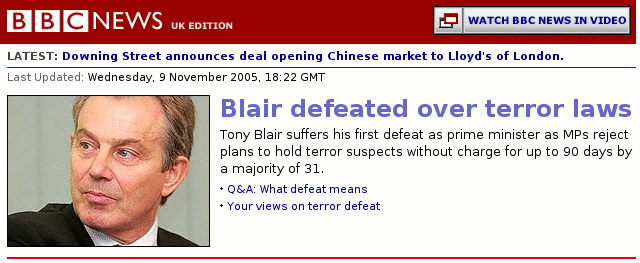
So who's to blame? Step up to the block...

Some headlines are so good, you can't help but cut out and keep them.

The detention period has, at least, been reduced to 28 days, which if nothing else shows that many MPs aren't willing to simply accept Police-led reasoning at face value.

There is, however, a little confusion over just what this means. Compare this quote from the BBC article above:

"But the prime minister's official spokesman said: "We don't see this as a matter of confidence in the prime minister as it was a proposal put forward by the police and which we supported.""

...which performs the traditional tactic of saying that "it wasn't our argument, it was the Police what made us say it" - the same tactic often used to shift blame to scientists and other "expert" advisers who merely provide one side of the story.

Now, further down the article, the same spokesman (it seems) claims that:

"The police and public supported what the government was trying to do...,"

So which is it - are the government supporting the police's request, or are the police (along with the public) supporting the government's proposal?

The difference is bound to be a vicious circle, ultimately, with Tony in the Commissioner's pocket and vice versa. The desired outcome, from both party's view, is obviously that both carry the blame. Which means that neither carries the blame. See how this works?

But as Curious Hamster points out in a very salient post (and dont' worry, I'll stop quoting him one day ;), this should not be the end of it - shouldn't be allowed to be the end of it. It is the Police's job to defend us against wrongdoers, fair enough, but parallel to this, it is also the politician's job to a) weigh up the arguments and evidence put forwards by a particular consulting party and b) consider that reasoning in the light of all other reasons being put forward. By completely ignoring the other aspects of this case - namely, civil liberties and the theory of freedom - Blair (the Tony one) showed his true colours - not as a reasoner (if that's a word), but as a guy who, committed to fighting odd wars, is threatened with the image of a legacy of "homeland" bombs. He knows that, given further incidents, people will certainly remember him as a failure.

The bind is that if he admits to a link between war and terrorism, he will also be seen as a failure - or worse yet, an instigator. To see things from his view is to see a level of personal pride, built upon 3 elections like the funeral pyre of a Roman emperor proclaimed as a deity. With his stepdown confirmed, it's becoming a race against time to put barricades in place, to offset the culmination of 8 years in power with a final run of even more stringent demands to stem the blood.

It's true - the higher the pedestal, the further there is to fall. The line between finishing in glory (only for his successor to inherit the haemorrhaging), and being booed off the stage is now a fine one, sandwiched between an increasing desire to do something (anything!), and the increasing results of having done something.

What should he do then? A pickle, he is in. Pride before a fall, etc. We're still seeing the effects of - and judging - Thatcher after all this time, and I suspect Blair won't be any different. He may bow out whichever way he can now, but the real test will be in 10 years time once the database state is in full swing. The moralistic preacher in me longs to claim that there's glory in defeat and honour in admission - an apology for the state of Iraq (whether or not you agree with the invasion, Blair must share some blame for the lack of foresight following it, in hindsight), and an acceptance of the possibility, even, between international tensions raised by the war and the state of national security we find ourselves in now.

But then, if we were in our own little ivory tower looking up at the stars and how they spelt out our name, who's to say we wouldn't be thinking the same?

To end, it's good to see that Devil's Kitchen are celebrating in true limericky style. Let's see what we can concoct for the occasion...

He wanted a 90-day limit
But his own MPs voted to bin it
"Three months behind bars?
That can go up yer ars!"
At this rate he'll be gone in a minute.

Hmm.

Security in the face of Security

A reminder that 4.30pm sees the report stage of the Terrorism Bill hit the vote Let's hope that MPs can actually make it this time, unlike the last.

Tuesday, November 08, 2005

Common Sense vs the Law vs Policy: "I Am the Law!"

"The Long View" on BBC Radio 4 this morning was a historical look at surveillance in society, with comparisons between city watchmen in the 19th century, and a look at a CCTV data centre of today. You can listen to it here.

Bill Rammell says that Universities have nothing to fear from the Terrorism Bill, but the Universities aren't so sure. Loose legislation backed up by a sense of trust seems to be the norm these days - indeed, a lot of the difference in opinion comes down to the same idea - that a large proportion of judicial action is to be inferred, and carried out more according to some idea of "common sense" than formal decree. Isn't it exactly that level of flexible ambiguity in law that the modern system evolved to avoid? Maybe it's time to do away with laws completely, and rule simply by common sense - many seem to think that a plausible option under a civilised government.

Are laws there to guide or restrict policy-makers? Will legislation evolve to take inherent common sense into account, or will the holes left in new Bills simply let politicians expand to interpret them as they want/need? Let me think^W read some Judge Dredd for a moment...

Meanwhile, I wrote a fax to my MP. Hopefully he'll reply this time.

Monday, November 07, 2005

YouGovWikaProID

Some quick, random bobs n bits:

Curious Hamster takes a look at the recent YouGov poll. Not had much chance to look at it properly myself yet though.

Have added Into The Machine to Wikablog, which may explain the new button on the right. If you're so inclined, feel free to head over and review us.

Also I seem to have ranted more than I expected over on Neil Harding's summary of the ID System debate. Neil is one of the few pro-ID System bloggers out there, so it's good to have someone who's willing to put the other side of the argument across. Challenge and discussion is sorely lacking in this era.

Thursday, November 03, 2005

It's all in the Timing...

Curious Hamster picks up on the timing of the release of 999-call material, and the backlash on anti-terrorism laws. I seem to remember similar material being made available following September the 11th, but can't recall if it coincided with similar US legislation...

Quote of the day

"Mr Marshall-Andrews said: 'There is no defence, there is no proviso which is placed in the act which would enable Cherie Booth QC, if the director chose to prosecute her, to defend herself.'"

Info Commissioner criticises ID Cards Bill

Oops, almost let this one slip. Information Commissioner Richard Thomas has a proper go at the ID register. (You can read his statement hither.) Note this quote...

"The extent of the information retained as a core part of the National Identity
Register is unwarranted and intrusive.
"

Make sure your MP gets to read it.

(Also added to the badly-CSSed list of reports.)

Wednesday, November 02, 2005

International Data Retention

This is bizarre. Or, at least, the point where my knowledge of trans-national business/privacy laws breaks down.

O2, the second largest mobile operator in the UK, has been paid £875,000 to retain call data for a year. So first-off, that's public money being used to keep tabs ("spying", some might say) on the "public's" phone calls. (I say public, as a. everyone has a mobile phone now, and b. the plan's being extended to the other networks as we speak.)

But at the same time, a Spanish company, Telefonica, looks like it will be buying O2 up very soon.

The multi-level privacy aspects of this are confusing, although concerning either way. I'm not currently sure what the RIP Act says, although it looks like now that government plans have been thwarted by industries (complaining about retention costs) and civil liberty campaigners alike (although probably moreso the former...), they've opted for a different tack and are trying to get the data available through public-private economic coercion instead.

So does this mean that they're allowed to access the data, once it's stored and searchable, or does that still require some further passing of legislation?

And should we be raising questions about having this level of data being stored by a foreign-owned company? How do national/international surveillance laws get applied in this case?

Answers on a postcard...

Blunkett's relegated, Ian Blair rants

Forget about Scooter, it's all go on this side of the Pond. While Blunky, prior unofficial patron to these pages, realises his untenability and joins the ranks of the sordid backbench masses (again), how much pressure will Blair be looking at over the next few weeks?

Still, not to be outdone by the ever-dahling, media-hugging Minister, Metropol Police Commissioner Sir Ian Blair rants his face off in the Sun today (besides such wonderful headlines as "Sassy's guide to better bonks"... respect, Ian). The Commissioner should be up for a Booker next year, as he sets about weaving a tale of dark, grimacing times, smouldering violence and a life so post-nuclear that we'll be living off mutated rats unless we hand over all our power to him. "Trust us to beat bombers", the big letters say.

His comments should be taken in context of course. Near the end of the article where no-one reads, he affirms that...

"We have no interest in making Britain a police state. We have no interest in detaining lots of people but we do have an interest, and a duty, to detain some people long enough for us to understand what they are planning..."

Of course, why would the Police have an interest in a Police State? Similarly, why would the government want us to question their decisions less? If you lack the answers to these questions, I suggest giving up now.

The rule being played by both Blairs is that Police Powers are a necessity. This is where Ian stretches himself so marvellously, painting a picture so bleak it makes me want to hide under my desk right now...

"The reasons are simple. These people present a threat so profound that as soon as we begin to understand they are planning an attack we must disrupt them by arrest. There is no choice." (emph mine.)

"This is the new reality."

And my favourite...

"The sky is dark."

Obviously not living in a city, then.

The Police want our trust. Tony wants our trust, and our respect. And yet both of these sides have shown their complete willingness to burn the village down in the race for salvation.

The new reality is that the rules we've played by for so long - 2 centuries or more - no longer work. The global infrastructure that "we" are intent on relying upon has led to a sense of peace, yes, but also very serious artifacts that threaten that peace. The new "reality" is, perhaps, simply a disillusionment, as we find ourselves face-to-face with the harsh predicaments of our society in the dull daylight.

You can defeat bombers by strip-searching everyone in the street, and keeping them tagged from birth/entry. You can also start to get a long-term grip on what's really going on in the world, rather than ignoring causality and hoping that everyone will eventually come round to your way of thinking.

See, maybe there's a choice after all.

Update: Apparently it would cost too much to determine the background and motivation of terrorists.

Tuesday, November 01, 2005

Parcel tracking

Let me put this as simply as I can. One day I might get bored of going on about it. But not today.

Section 1, subsection (5) (h) of the ID Cards Bill says that information can be recorded about every time your details are accessed from the National ID Register. This is not restricted to use of the card - just when any validation is required (e.g. to confirm your fingerprints).

(In Schedule 1, section 7 expands upon this.)

Now in an interview with the FT, Andy Burnham is quite clear that ID Cards are designed to be as applicable as possible:

"We think ID cards could be the single gateway into a whole range of services that people need in their everyday lives from picking up a parcel or hiring a car to applying for a loan or registering with a doctor."

Amongst other things, why do the government need to know when I pick up a parcel? Furthermore, assuming the Post Office/Delivery Company track parcels by ID, this makes it a very simple, technically to know exactly who's sending parcels to whom. Again, why? I've yet to understand how this isn't a Big Brother plan.

(N.B. Section 7 of Schedule 1 above also says that information "may" be recorded. Does this, I assume, mean that the government aren't obliged to inform you, through the database, when they've been checking your details for whatever reason? Is there any way to know that we're being spied on?)

Monday, October 31, 2005

There's no business like Roadshow business

Andy Burnham's details of the Biometric Roadshow are enlightening, and prompt a multitude of follow-on questions.

Compare, for example, (or in B-Movie speak, "Be Per-plexed!") these two statements:

"The series of road shows was developed to build public awareness of the imminent changes to the passport..."

vs

"It would not have been able to accommodate a larger audience, had the road shows been publicised more widely [than the local media, a day in advance]."

In fact, despite Burnham's wishes for publicity ("I look forward to seeing as many people as possible as the roadshow travels round the country.") he seems to have done everything in his power to ensure that people only happen fortuitously upon the stall:

"Notice of the road shows was provided to local media [but no others] the working day before each event."


"The dates and locations of the road shows were not released to the public in advance."


"...the road show stand was designed to attract passers-by (e.g. shoppers) and the local media. It would not have been able to accommodate a larger audience..."

I never took architectury at school, so naturally I can't figure out a building-size-to-capacity correlation. From my vague A-level Physics knowledge, I seem to recall that if you want more space to put stuff, you have to build a bigger thing to hold it. Burnham et al seem to have missed this trick, and managed to design a stand to hold a relatively small number of looker-onners. Oops.

I'm also intrigued by this bit:

"As is usual practice, Ministers' movements are not confirmed in advance for security reasons."

Someone please enlighten me as to why we aren't allowed to know what any of our public ministers are up to in advance? Have anger levels really reached that point where screaming, naked NO2ID protestors are likely to run amok in a shopping centre, daubing Andy Burnham's face with barcode paint and shocking old grannies into submission by shouting "Nothing to hide! Nothing to hide!"

Or are far more mundane acts of inapproriateness (such as leafleting) included in this attack on our upright Ministers' "security" (being read alternatively as "embarassment").

As the BBC suggest, the roadshow was a nice attempt that seemed "to be preaching to the converted". But are the general public converted, or merely undecided? The decreasing popularity of the ID system perhaps indicates the latter, in which case the roadshow can onyl be seen as damage limitation.

Plan of attack

Blogging perfect.co.uk's plan of attack cos I keep forgetting to do so.

Related reading this week: Sun Tzu on The Art of War. (Alternative Translation.)

Sunday, October 30, 2005

Policies of Titanic decision: Why Booze is a Scapegoat

Theresa May claims that government plans to ban alcohol on public transport, alongside its steps for longer drinking hours, show that the government is in "complete disarray". More of her comment in the BBC article, where she backs dropping the proposals for 24 hour drinking.

There are, I think, many points being bandied around, but no-one seems to want to address any of the fundamental issues involved here. We can talk about banning booze, licensing hours and the "right" to go unharassed in the street as much as we like, but as long as we restrict ourselves to these lines, we only consider effect, and never cause.

In 1994, Rod Rhodes set out a vision of the "Hollowing Out of the State", encapsulating a group of trends that made up a loss of control by the British State. While he considered factors such as increased European governace, and increased privatisation as being part of the scenario, over the last 10 years, the situation has perhaps diversified even further. Relevant to the increased level of drink-related problems is not just the Hollowing Out of the State, but also of the Public. The difference between these two, and mirrored in their reactions, is that one has direct access to legislation, whilst the other merely has the tools that have been left to them over an extended period of disempowerment.

One of the (more sensible) observations directed towards unsavoury activity is that often there just isn't much else to do. I haven't heard of any empirical evidence to back this up (let me know if you have), but I believe that this is an important (certainly not the only) factor in explaining our current malaise. The purpose of a State is partly to combine decisions, and partly to exert power (to implement those decisions). Without either one of these, the State is effectively useless - either it can't decide what to implement (or implements badly), or it lacks any authority (at all, rather than in the -arianism sense) to have any effect. If Rhodes is particularly insightful (and I don't see why he isn't) then much of both of these have been removed from our government, for a variety of reasons (not least, for example, the 1980s).

The flipside, or perhaps simply the extension, of this, is that power has also been removed from the people the government represent. Firstly, there is the loss of power that used to be invested in government, but is now in further-removed hands as outlined above - primarily non-democratic industrial players, and European politics. Secondly, as Whitehall struggles to appear effectual in the spotlight of media attention, its grab for power/attention can often come at the expense of local government, widening the gap between the public and their "voice". And thirdly, as a new era of communication is ushered in (following the globalised industrial comms era), whereby those with the facility and the know-how to form ad-hoc alliances and pressure groups do so, the voice of the "public" is increasingly skewed towards a relative minority. This blog could be held as proof of this, perhaps...

The end result of all this is a government and the majority of a public caught in limbo, between a large, complex variety of actors and parties, all of whom have their own agenda, and all of whom are well-versed in keeping the pace of politics ticking over so fast that keeping up is difficult - especially when you work 45 hours a week, or have a mountain of paperwork to climb.

And so we are the heirs to a government that must apply ever harsher (read "media-grabbing") measures in order to court public opinion, and a public that resorts to the menu of cheap cocktails as their remaining source of choice. We are, and shall be for a while, stuck in this vicious cycle of despair, escape, revelry, and desparate measures which lead to more stringent law, and an increased lust for escape.

This is why relaxing drinking laws is both a couragous step, and a foolish one. To address one part of the cycle but not the others may have a breaking effect on it, but this will probably take a fair while more than the 4 year election cycle. If the other factors affecting the situation aren't realised at the same time - working hours, disempowerment, et al - then all that tension will simply be released into a 24 hour binge, and the plan will fail. The policy ship will jhave ploughed head first into an iceberg it thought only surface frost.

But each party involved is too concerned about how they come across to others to change anything.

Update: This quote from Lib Dem Mark Oaten sums a lot of it up... "This government seems obsessed with banning things." Jail time and heavy laws may achieve a "peaceful" society, but where's the Respecttm, Tony?

Tuesday, October 25, 2005

Are you up4ID?

Into The Machine is proud to unveil its latest initiative: The up4ID campaign. For too long, the voices of the terrorist-loving, anti-public, liberalist monkeys have been the only ones occupying the stage of debate. No longer! We reveal just why an ID system is bloody brilliant, and vie for your support to help out all those poor MPs who must be feeling rather besieged by now. Click now! And tell all your (non-wimpy) friends!

Sunday, October 23, 2005

Police stop and search 'rising'

"Over half of 18 forces in England and Wales said they had stopped more people in the last three months than in the previous year." Not sure how much that gets skewed by the conference season, but it can't be a huge amount - looks like military bases and the like are more responsible for the increase in figures. Can't see a link to any source figures though.

Friday, October 21, 2005

Rhetoric vs Debate: A Truly Public Strategy

Richard Veryard looks at the information sharing aspects of the MI5 statement on the sources of information as reported by Channel 4 News. The original PDF is here, and the BBC have a report following it up, too.

The context is that, as the BBC put it, the Law Lords "are examining whether the UK government should have to check whether intelligence it uses has been obtained by torture." The document is the statement by MI5 chief Dame Manningham-Buller with respect to this, and I suggest taking a look at Richard's summary linked to above for a good account of what it contains. Lord Falconer also had some stuff to say on this a few weeks ago.

There are naturally many facets to this - the balance between revealing information and revealing sources, as Richard points out, and the ethical legitimacy of information-obtained-under-duress, which is what the Law Lords are looking at. As such, I'm not going to harp on about what decision the Lords should come to. I'm sure they have more time to look into it than me.

Instead, I'm merely going to draw some parallels amongst the arguments being raised here and the state that we find ourselves in, in order to bring attention to the rhetoric used and hopefully raise some interesting questions to answer later. In some ways, this is part of the remit of the Lords, but in others it considers broader implications that they probably aren't touching on.

There are 2 main reasons put forth by Dame Manningham-Buller in favour of not worrying about the source of information, even when it is "apparent to the Agencies that the intelligence has been obtained from individuals in detention". That is, when there is reasonable suspicion of the involvement of torture. Compare this to the "trend" in anti-terrorist legislation to define 'knowledge, belief or reasonable suspicion of wrongdoing' (or, indeed, intent of wrongdoing) as being the tipping point for a third party being implicated in the guilt as well. Should we, as public, not also have the ability to make decisions based on our suspicions? Apparently not. Anyway, to those arguments...

Life, Liberty, Happiness

The first is that "where the reporting is threat-related, the desire for context will usually be subservient to the need to take action to establish the facts, in order to protect life." (My emphasis.) This is a line we see consistently repeated - indeed it may well be the line to take, established as it has been by the PM himself on various occasions:

"...how can I responsibly refuse to something that will actually protect ... the most basic civil liberty which is the right to life?"

This is certainly something that needs looking at, and thinking further about, for it's clearly a sentiment designed to invoke strong emotion, polarise people's instincts, and segragate those who argue against "life". In this sense, then, the statement mirrored by both parties can be seen as a form of "non-national" patriotism, and only barbarians would argue otherwise. The difference between the two, of course, is that the role of MI5 does not extend to casting judgement over a whole nation. The important thing to remember, though, is that Mr Blair continues to prove that he is in the arms - mutually, of course - of the Police and of the Intelligence services. This can probably be traced back to the fact that populations do tend to quite like a feeling of security. (Whether they actually get given such a feeling is another matter.) Anyway, this is a powerful argument - but powerful arguments are often used to justify a large array of otherwise-questionable practices.

The question that we, as the beneficiaries of Blair and Co.'s altruistic powers, should be asking to both Whitehall and ourselves is: How far will we go to defend ourselves? Unless we are able to at least say that we do have some limit - whether it be personally and individually, or on a social basis as a whole - then we face an ever-increasing slide into becoming a nation that is willing to do anything so long as we sets out, at some point along its journey, to preserve our own life. The fact that this may involve killing members of our own population, or any other such "side-effect", becomes less and less important under this banner, and eventually a SAD (Self-Attained Destruction) State results. This is very much the direction we are headed in.

In other words, this is not as black-and-white as the politicians, the intelligence agencies and the afraid public would like it to be. The practice of using preservation of life is a dangerous justification if not backed up by concern, debate, accountability and a desire to determine what ill effects such a policy is having. Unless we have all these, and an attitude that takes human rights seriously in the face of "attack", then we leave ourselves wide open for many, many miscarriages of justice to go by completely unnoticed and unrecorded. This is a heavy burden to bear, no matter what their argument.

Diplomatic Doublethink

The second argument for ignoring suspicion of the use of torture is the "importance of co-operation between States in countering the threat from international terrorism." Furthermore, "...material [shared under this] ... includes detainee reporting which has proved to be very valuable in disrupting terrorist activity." (Note here that of the 2 cases presented in the statement, 1 - the latter - clearly starts off by demonstrating just how wrong and misleading "vidence" obtained under duress can be.)

As with the sacrifice of liberty in the name of life, above, here we again see the ceremonial parading of a "worthy goal" to undermine efforts for justice elsewhere. Again, this argument is parroted by Tony B, as he sweeps aside one wrong in order to justify another. Perhaps on this front he's been carefully learning from tactics used all over the world - for instance, per the US support for Uzbekistan.

The point here is again not to argue against the (perhaps laudable) aim undertaken by our leaders, but to highlight the balance that is often lost when one becomes fixated on a particular target. The image of a plate-spinner, juggling a dozen ceramic dishes on poles comes to mind - by tending to one potential disaster, eleven others are lining up, ready to bring destruction. The difference between the analogy and reality, though, is that our government have settled into a mode of thought in which only the one plate matters, and it is thought that it will be fine to leave the others until we have got this single, lone dish perfectly balanced, spinning forever. I hear a lot of crashing going on.

So this reveals the hypocrisy inherent in a single-focus campaign against a vague entity such as "terror". The wool to have been pulled over our eyes is to have defined "terrorism" as the evil in the world - to create the illusion that, because it can happen to us, all other injustice is of a secondary nature to this central threat to world peace. Perhaps ex-dictators can mock the Western-induced court process because they are aware of just how hypocritical this campaign is - many years of meting out injustice, and having it acknowledged - and let slide - put a very different perspective on world affairs to that presented by the spin machine.

Moreso, it is our lack of courage in admitting our international tensions that is the most telling. To uphold the image of saintliness, and to admit the realities only internally, behind the scenes, is even more damaging than acknowledging the state of global affairs as it really is. And, I feel, it is this that most disappoints the British public, and discourages them from caring, or from even questioning. The human mind is relatively good at knowing when it's being lied to. All it needs to do now is to express this in real terms.


I would like to think that the result of this is not that we should be asking tough questions of the Cabinet, or of our MPs, but that we should in fact be asking tough questions of - and demanding tough answers from - ourselves. Despite ten-a-penny authoritarian claims, public opinion is still the deciding factor in the fate of many policies. And as such, public debate and public consciousness need to be a driving framework in what kind of nation will we be in 5 or 10 years. By demonstrating that we have a grip on these subjects, as well as an opinion, the ears of those who currently feel that they have the run of the house may just be opened a little.

Thursday, October 20, 2005

Terrorists don't ride bikes

Eh? The Terrorism Act was used to arrest a woman in Dundee for walking on a cycle path?


A spokesman for Forth Ports said: “We will robustly prosecute anyone who breaches these new security measures because they have been introduced by the Government and we are obliged to enforce them.”


I feel a database coming on. Not an identity database. A "dumb use of law" database - these things need to be documented. Now if only I had some time...

Tuesday, October 18, 2005

ID Cards Pass the 3rd Hurdle

The ID Cards Bill has survived its 3rd reading by majority of 25: 309 votes to 284. Expected, I think.

Encouragingly, there was at least a good level of sensible debate in the hours leading up to the vote, from what I saw. Just a shame that the vast majority of the people in it were people who had already decided against ID Cards, leaving the others under the scourge of their whip to ignore rationale.

Winds of Change

Don't be alarmed. "Blunkett is an Arse" is no more. The puerile name was fun, but a Rose by any other name is still a Rose, and the joke was getting a little old. So this is, in a way, "Arse 2.0", but in many other ways (i.e. all of them), it's still the same blog. The time is right to embrace the change.

And it's not the only change to be embraced. Today, I fear, we'll also be seeing the triumph of the 3rd ID Card reading, despite Kennedy's urges, as it were. Quite whether the issue is helped or overshadowed by other decisions to be made is up for debate. Still, I'm not expecting any miracles. I only say this so that I may be proved wrong...

More comment soon.

Saturday, October 15, 2005

Wither debate? And who are our captors?

Don't worry, we're still here - watching, learning, taking stock. Things are a bit quiet at the moment due to external pressures, so until we get our teeth back into it, here's an interesting comment from Martin Kettle in today's Guardian, regarding the level of discussion surrounding the terrorism bill.

Also some interesting points currently being made on this issue on Any Questions - namely that the extension in detention to 3 months by the bill is being driven (supposedly) by the sheer amount of data the Police have to go through - CCTV footage, hard drives, links to chase up, et al. Let us ask ourselves if we are making ourselves safer through the increase of surveillance technology, or if we're further and further becoming trapped by our dependence on this culture of reliance on monitoring information. Who needs terrorism to disrupt lives when we've constructed the cage ourselves?

Wednesday, September 28, 2005

Hurly Burly

Report anything unusual, or suspect-looking, you say?

There are several suspicious-looking (unmarked, one rented) vans and people-carriers sitting around outside my house, hovering on double yellows, with various burly-looking blokes in them.

I'd be tempted to report them, if I didn't know they were Police.

No heckling, no photos. Just sit and clap, please.

How to piss off your own party members. Good job, boys. Dem terrorrists sure are pesky.

Regarding seizure of media footage, I've heard some thoughts before about schemes such as wireless-enabled cameras to send data remotely asap. There are definitely a wireless camera or two out there, but nothing that does it automatically, AFAIK. Anyone have any hints or tips?

Update, 30th Sep: Well, Blair and Straw have apologised now that Wolfgang (suspected terrorist) has become a national hero - it's amazing what a little press coverage can do. No such grace, however, for the 600 innocent people stopped and searched throughout the conference*, or for the various local people getting arrested for bearing anti-blair slogans, under the anti-terrorism act, no less.

Hecklers, protestors and people doing nothing are all terrorists now. This turned into a comedy farce a while ago.

* An unmissable quote from the police spokeswoman:

"By definition, many totally innocent people going about their normal lawful business will be stopped and checked," she said. "This is what creates the deterrent for terrorists."

There's definitely a push for the norm to become a population of innocent people prepared to put up with whatever crap the police push onto them. The true effects of this continue to go unquestioned.